
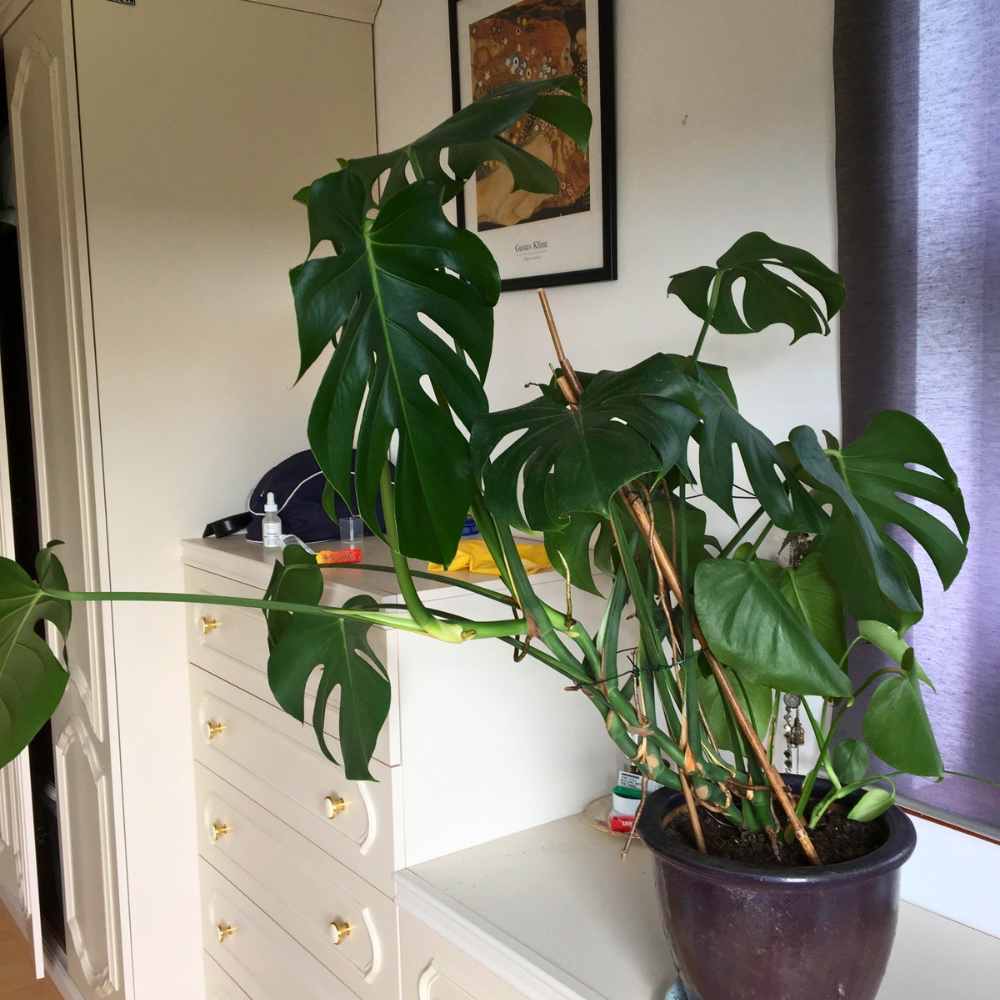
Monsteras have an annoying habit of growing however they want. And sometimes, that means sideways, diagonal or even leaning towards the window.
If your monstera is growing sideways you’re not doing anything wrong. But there’s usually a reason – and often a pretty simple fix.
Monsteras are natural climbers. In the wild they spend their whole lives climbing up trees in the rainforests using aerial roots to hold on as they go. When you bring one indoors and put it in a pot,l that climbing instinct doesn’t just disappear. Hence the leaning.
I’ve had my monstera for about three years now. For the first year I kept rotating it, propping it up with stakes and wondering why it kept falling over or reaching sideways toward the window.
Eventually I figured out it wasn’t one single problem – it was usually a mix of a few things. Light, soil, support (or lack of it) and the way I was watering all played a role.
This guide takes you through all the main reasons a monstera grows sideways and what you can do about each one. We’ll cover light, support structures, root health, repotting and a few other things that don’t get talked about enough.
Quick Answer
- Light Direction: Monsteras lean towards the light. So rotate the pot every week and make sure its in bright, indirect light.
- No Vertical Support: Without a pole or stake the stems grow out instead of up. Give it a moss pole or trellis to guide it’s growth.
- Crowded or Heavy Growth: Big leaves and long stems can pull the plant sideways. Prune it a little and secure the stems to a support.
Why Monsteras Grow Sideways: The Main Causes
Before getting to the fixes it can help a little to understand what’s happening when your monstera starts to lean. A monstera growing sideways is almost always telling you something – either it’s chasing light, it doesn’t have the support it needs to grow upright, its roots are struggling or a mix of all of those.
The good news is that none of them are death sentences. Monsteras are tough. They will bounce back when you deal with whatever the underlying issue is that’s causing the problem.
1. It’s Chasing the Light
This is by far and away the most common reason and it’s also the easiest to overlook because it happens gradually. Monsteras, like most plants, grow toward the light.
If your light is coming from one direction like a single window, a lamp in the corner etc. then the plant will lean that way over time. A few weeks of this and your monstera will look like it’s trying to grow through your wall.
Monsteras do best in bright, indirect light. If plants don’t get enough log it they grow weak, elongated stems that can’t support their own weight – which makes any sideways growth even worse.
The fix here is almost always about either improving the light or rotating the plant.
A few things that help:
- Rotate the pot a quarter turn every 1 to 2 weeks. This sounds simple.. and thats because it is! Rotating your monstera on a regular basis encourages it to grow more evenly in all directions rather than leaning hard toward one side.
- Move it closer to the light source. If your monstera is sitting 6 to 8 feet from the nearest window try moving it closer, to 2 or 3 feet away. Even a few feet closer makes a big difference.
- Avoid direct sun. Bright but indirect is the what your monsters loves. Direct sun in the afternoon through south or west facing windows can burn the leaves which will only give you even more problems.
One of my monsteras spent two years near a north facing window in a corner. It leaned so much I eventually had to prop it up.
When I did move it, after far too long, to an east facing window it only took a few months before it had straightened up entirely. I felt a bit silly that the fix was that simple.
This monstera light guide will take you through exactly what they like and need.
2. Lack of Support
This one can throw a lot of people, especially if you’re new to owning a monstera. In the wild monsteras don’t grow upright on their own – they lean against and climb up trees.
The aerial roots you can see hanging from their stems? It uses those to anchor itself and to get water and nutrients from the surfaces it’s climbing.
When you put a monstera in a pot with no support you’re asking it to do something it wasn’t designed to do. It’ll grow outward and sideways because that’s easier than growing straight up with nothing to hold onto.
Adding support makes a real difference.
The best options are:
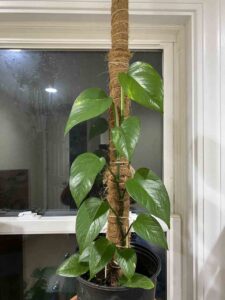
- Moss poles (coir or sphagnum). These are widely considered the best option for monsteras because the aerial roots can attach to the moss and absorb moisture from it. Keep the moss a little damp and you’ll notice the plant starts to grow more vertically over time. It won’t happen overnight but give it a few months and it should happen.
- Bamboo or wooden stakes. These work in the short term or with smaller plants. They won’t encourage the aerial roots to attach the way moss poles do but they’ll hold the stem upright while the plant sorts itself out.
- Trellis panels. If you have a larger monstera that’s already spread out wide then a trellis panel behind it gives lots of different points where the plant can attach to it. And it looks pretty good too.
When you add a moss pole make sure you use plant ties or strips of old fabric to hold the main stem to the pole. Don’t tie it too tight or you’ll want strangle the poor thing – just use the ties to guide it. Over time the aerial roots will do more of the work.
For more help see our guide to getting a monstera to climb or some really great support ideas.
3. The Pot Is Too Big (or Too Small)
Pot size matters more than most people think or understand. If your monstera is in a big pot the roots spend most of their energy growing into all that extra soil rather than holding the plant in place.
The roots essentially stay shallow and spread out, which means there’s not much holding the plant steady. If the plant also has a heavy stem and large leaves then there’s a good chance it’s going to be keeling over at some point.
On the other end is a rootbound monstera – one that’s been in a pot that’s too small for too long. It will also struggle to support itself.
The roots get so compressed they can’t function the right way and the plant gets stressed. Stressed monsteras tend to grow in weird directions as they reach for whatever resources they can find.
The general rule: repot when you see the roots circling the bottom of the pot or if they’re growing out of the drainage holes. Then get a new pot that’s only 1 or 2 inches bigger in diameter than the current one. Going up something like 4 or 6 inches at once is usually too much.
A few things to keep in mind when repotting:
- Don’t disturb the roots more than necessary. Be gentle with them as you pull any apart that are circling. Don’t hack your way through them.
- Use a well draining mix. A standard potting mix with some perlite (roughly 80% potting mix, 20% perlite) drains well enough to stop root rot while staying moist enough for the plant.
- Water thoroughly after repotting, then let the soil dry partially before watering again. Repotting is stressful and the plant doesn’t need waterlogged soil on top of everything else.
4. Overwatering or Root Rot
Root rot is sneaky. The symptoms above the soil – yellow leaves, drooping stems, plants growing in strange directions – look a lot like other problems so it can go a while without being diagnosed. By the time you notice something’s wrong the roots can have been struggling for weeks.
When the roots are damaged by rot they can’t absorb water or nutrients very well. The plant gets weaker as a whole.
The stems become soft and can’t hold themselves upright. Growth slows and can becomes erratic with the plant growing out in whatever direction takes the least effort, which is usually sideways.
When it comes to water monsteras like to dry out a bit between each time. The usual rule of thumb is to stick your finger 2 inches in the soil. If it’s still moist then wait before you water again. If it’s dry then you can be confident about watering thoroughly until it drains out the holes at the bottom. This guide will tell you how much water a monstera needs.
If you think it might be root rot:
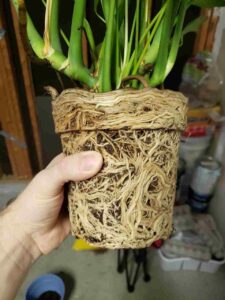
- Unpot the plant and look at the roots. Healthy roots will be white or a sort of tan color as well as firm. Rotten roots are brown or black, will be mushy and theres a good chance they’ll smell bad.
- Trim off all the rotted sections with either scissors or pruning shears. Rinse the remaining healthy roots (but be careful not to damage them so be gentle).
- Let the roots dry for 30 to 60 minutes before repotting into fresh mix that drains well.
- Don’t water for a week or so after repotting to give any trimmed root ends a chance to build up a callous.
Prevention is a lot easier than treatment when it comes to root rot. If your pot doesn’t have drainage holes that’s also something you’ll want to fix. Monsteras sitting in soggy soil, even if alright at the moment, are very likely to develop some problems soon.
For a more in-depth guide try our steps to rescue a monstera with root rot.
5. Weak or Leggy Growth From Low Light
This is related to the light issue above but slightly different. When a monstera doesn’t get enough light it goes into a kind of survival mode.
This means it grows longer internodes (which are the sections of stem between leaves) as it stretches toward whatever light it can find. But that results in a plant with long, thin stems that can’t support themselves.
Leggy monsteras look stretched out with bigger gaps between the leaves than you’d normally see. The stems are usually thinner than they should be too.
This is sometimes called etiolation and while it’s not immediately fatal it does weaken the plant over time and makes sideways growth much more likely.
The fix for a leggy monstera is just more light. But if you’ve been in a low light situation for a while, you might also want to prune some of the leggiest growth.
This will encourage the plant to put energy into new, stronger growth instead of having to maintain those long weak stems. Cut just above a node (the bump on the stem where the leaves and roots grow from) and the plant will branch from that point.
Those cuttings, by the way, can usually be rooted in water or moist sphagnum moss and grown into new plants. So it’s not wasted.
6. The Growing Medium Is Too Dense or Compacted
Soil that’s too dense stops the roots from growing which affects the plant’s stability. Old potting mix also breaks down over time.
After a year or two it can become compacted and lose the aeration that keeps the roots healthy. Dense soil stays wet longer too which circles back to the risk of root rot.
If you haven’t repotted your monstera in 2 or 3 years then the soil alone might be having a big impact on it’s sideways growth, even if the pot size is fine. A, fresh mix makes a difference too.
A mix that works well for monsteras:
- 60% quality potting mix
- 20% perlite
- 10% orchid bark (adds aeration and texture)
- 10% worm castings or compost (not necessary but helps with nutrition)
You don’t have to be very precise about this. All you want is a mix that drains quickly, doesn’t compact easily and holds just enough moisture without staying soggy.
7. Odd Watering Habits
This might sound like it’s not important but it can make a big difference. Watering unevenly – so things like always pouring water on the same spot or never watering all the way through – can cause the roots to develop unevenly too. One side of the root ball gets a lot more water and nutrients and the plant grows more in that direction.
The fix for this is to water slowly and evenly around the entire surface of the soil making sure water reaches all parts of the roots. Water until it runs out of the drainage holes. This makes sure the all of the roots gets access to the water they need and encourages more even growth overall.
Also worth mentioning: bottom watering (putting the pot in a tray of water and letting it absorb the water from below) is popular for some plants but can also result in the surface roots staying shallow. For monsteras top watering is better and ends up with stronger and more evenly distributed roots.
How to Straighten a Monstera That’s Already Leaning
If your monstera has been growing sideways for a while it will take some work and patience to get it straight again:
- Identify and fix the underlying cause first. Straightening a monstera that’s still in bad light or still overwatered won’t work. Deal with the root issue (literally and figuratively) before worrying about how it looks.
- Add a support structure. A moss pole or stake gives the stem something to lean on while it builds the strength to hold itself up.
- Tie the main stem to the support. Make sure the ties are soft and don’t force the stem – if it’s been growing sideways for months you won’t be able to straighten it all at once without the risk of it breaking. So your best bet is to guide it gradually over a few weeks.
- Rotate the plant regularly. Once you’ve got the light situation right then rotating it will encourage straighter growth.
- Be patient. A monstera that’s been growing sideways for a year isn’t going to be perfectly upright in a month. But with the right care that you stick to the new growth will come in stronger and more vertical.
One thing to accept: the older growth that grew sideways will more or less stay at that angle. Plants don’t really “unbend”. What you’re working on is getting new upright growth from the growing tip, which will make the plant look better over time.

When to Prune vs. When to Stake
This comes up a lot. If your monstera is growing sideways because of a long, leggy stem that’s weak you have two options: stake it or prune it back. Which one makes more sense will depend on your situation.
Stake when: the stem is healthy and structurally sound but just needs some guidance. It’s growing well just in the wrong direction!
Prune when: the stem is etiolated (thin and leggy), the leaves are small or not properly developed or the plant has just become too large to manage. Pruning tells the plant to put energy into new growth from lower nodes which then usually to come in stronger.
Pruning a monstera is less scary than it sounds. Use scissors or pruning shears that you’ve cleaned beforehand (wipe them with rubbing alcohol so they don’t spread any disease), cut just above a node and the plant will branch from there. Give it a few weeks and you’ll see new growth.
Monstera Growing Sideways: Quick Summary
If you’re scanning this looking for the short version:
- Most common cause: not enough light or light from only one direction. Move the plant closer to a bright window and rotate it more often.
- Second most common: no support structure. Give it a moss pole and let the aerial roots grow and the plant will climb.
- Also worth checking: pot size (too big or too small), quality of the soil, how you’re watering and the health of the roots.
- Straightening existing lean: deal with the root cause, add a support, tie the stem and be patient – new growth will come in more upright.
Monsteras are forgiving plants. They don’t mind a fair amount of neglect and will still bounce back if you give yours the right conditions. If its growing sideways right now don’t worry, you haven’t ruined it – you’ve just got a little work to do to fix it.
Best place to start is with the light. That’s where I’d always look first.
