
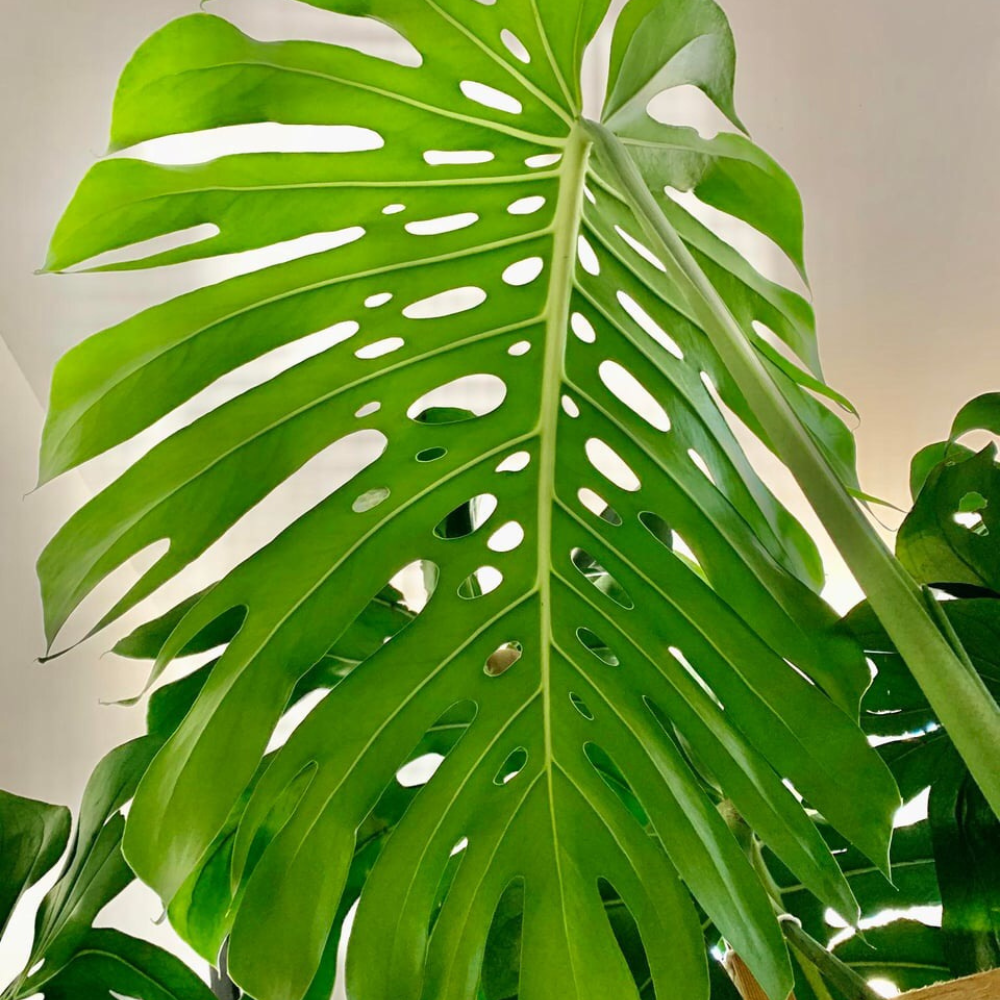
For longer than I care to admit when I got my first monstera I didn’t fertilize it. Not once. I figured it was growing fine and adding fertilizer was just one more thing to remember and probably something I’d mess up.
Then I met someone who had a monstera that was over three times the size of mine, with leaves so big they almost looked fake. When I asked what her secret was she just laughed and said “I feed it”.
And that’s when I realized I’d pretty much been starving my plant.
Monsteras don’t need a lot of feeding but during their active growing season in the spring and summer they benefit from fertilizer biweekly or even just once a month. What you have to be aware of is that your monstera lives in a pot with a limited amount of soil. Once it uses up the nutrients in that soil there’s nowhere else to get them unless you give it fertilizer.
So this guide will tell you everything you need to know about fertilizing monsteras and how to use it to kickstart your plants growth.
Quick Answer
- Use a Balanced Fertilizer: A liquid houseplant fertilizer such as 10-10-10 or 20-20-20 will help to get strong leaves.
- Feed During Active Growth: Fertilize every 4 to 6 weeks through the spring and summer when the plant is growing new leaves.
- Avoid Overfeeding: Too much fertilizer can burn the roots. Use a diluted solution and don’t feed in the winter.
For more help see our Monstera Care Guide for Easy Tips to Grow Monstera.
Why Monsteras Need Fertilizer
What confused me at a bit at first is that monsteras are known as being easy and low maintenance houseplants. So why do they need fertilizer?
Your monstera plant, like many other indoor plants, is likely to remain in the same soil for most of its life. That means the nutrient levels in the soil will get used up over time.
When growing in the wild plants get nutrients from decomposing leaves, organic matter constantly breaking down and rain washing minerals through the soil. Indoor plants don’t have any of that.
So every time you water your monstera you’re washing nutrients out through the holes in the pot. After a few months even the best potting soil is going to be lacking in a lot of necessary nutrients.
Fertilizer is a bit like vitamins for your plant. Your monstera can survive without it – mine did for a while – but it won’t grow at its best. It’ll produce smaller leaves, grow slower and you won’t get the big holes in the leaves you probably want.
What Fertilizer Does
Fertilizer replenishes three main nutrients that plants use in large quantities:
Nitrogen (N) – This is for leaf growth. Nitrogen is what makes your monstera produce big leaves instead of small ones. Nitrogen, which is necessary for leaf growth, is more important than the other two for your monstera’s health.
Phosphorus (P) – This supports root development and the health of the plant. Strong roots mean a strong plant.
Potassium (K) – This helps regulate water use and strengthens the walls of the cells. It basically helps your plant function properly.
On top of that these fertilizers also contain micronutrients like iron, magnesium and calcium that plants need in smaller amounts but are still essential.

The Best NPK Ratio for Monsteras
Every fertilizer has an NPK ratio listed on the bottle. If you’re not sure what it is look for three numbers like 20-20-20 or 3-1-2. These numbers tell you the percentage of nitrogen, phosphorus and potassium in that fertilizer.
So – what’s the best ratio for monsteras?
Opinions vary a bit but what I’ve learned from research and experience and has worked for me is:
The 3-1-2 Ratio (Most Popular)
The magic formula is 3-1-2 (nitrogen-phosphorus-potassium), with three parts nitrogen to one part phosphorus to two parts potassium. This gives your monstera extra nitrogen for leaf production while still giving it the other nutrients it needs.
Fertilizers with this ratio might be labeled 3-1-2, 6-2-4, 9-3-6, or any multiple of that basic ratio. They all work the same way.
I use a 5-2-3 fertilizer specifically marketed for monsteras, and it’s been great. But you don’t need monstera-specific fertilizer – any 3-1-2 ratio works.
Balanced Ratios (Also Work Fine)
Monstera plants need a balanced fertilizer and so ideally you should use a fertilizer labeled with NPK 20-20-20. Balanced means equal amounts of all three nutrients – 10-10-10, 20-20-20, etc.
Both the 3-1-2 ratio and balanced ratios work. I’ve used both. The 3-1-2 gives you slightly bigger leaves but balanced fertilizers are easier to find and more than good enough.
What to Avoid
Don’t use fertilizers that are super high in nitrogen – like the ones marketed for lawns or vegetables. Something like 30-10-10 will give you tons of leafy growth but weak roots and stems.
Also avoid anything with very unequal ratios. A fertilizer labeled 13-4-5 has too much nitrogen for houseplants.
Types of Fertilizer: Liquid vs. Granular vs. Organic
There are a lot of fertilizer options out there. What I’ve tried and what works are:
Liquid Fertilizer (My Favorite)
Liquid fertilizers are concentrated solutions that you dilute in water and pour onto the soil when you water your plant.
I love these because they’re easy to control. You can dilute them to exactly the strength you want and they they get distributed evenly through the soil. Liquid fertilizer can be used more frequently as well because it will be processed through the soil more quickly.
The downsides to them? You have to remember to use it. There’s no “set it and forget it” option with liquid fertilizer.
I use liquid fertilizer every time I water during spring and summer. It sounds like a lot but I dilute it to half strength so it’s really just a consistent feeding schedule.
Granular Fertilizer
These are dry pellets or granules that you sprinkle on top of the soil or mix into the potting mix. They release nutrients slowly as you water.
The benefit is convenience as you only have to use them once and you’re good for a few months. Granular fertilizers release more slowly and should not be applied as often as liquid fertilizer.
The downside is less control. You can’t adjust the strength and it’s easier to accidentally over fertilize.
Fertilizer Spikes
These are sticks you push into the soil that slowly dissolve over time.
I tried these once and wasn’t impressed. The nutrients don’t get distributed very evenly. They’re concentrated around wherever you pushed the spike in. But some people love them for the convenience.

Organic Options
Worm castings are my favorite organic fertilizer. They’re basically worm poop and they’re packed with nutrients and beneficial microbes. I add a handful to the top of my monstera’s soil a few times a year.
Compost also works great if you have it. Just layer some on top of the soil.
The benefit of organic fertilizers is they release slowly and it’s almost impossible to burn your plant with them. The downside is you have less control over the exact NPK ratio.


When to Fertilize Your Monstera
Timing matters way more than I initially thought.
Spring and Summer: Active Growing Season
Fertilize every two to four weeks during the period from mid spring to mid fall, usuLlh from spring through early fall once or twice a month.
This is when your monstera is actively growing and producing new leaves. It’s using nutrients like crazy so this is when fertilizing makes the biggest difference.
I fertilize mine every time I water from March through August. That’s about every 7 to 10 days but I use diluted fertilizer (half strength) so I’m not overloading it.
Fall
As days get shorter and the temperatures drop your monstera will slow how much it’s growing naturally. Fertilize every 2 weeks during the growing season (March to August), monthly in September to October and rarely in the winter.
I cut back to once a month in September and October.
Winter
Monstera won’t need fertilizer during its dormant period in late fall and winter.
From November through February I don’t fertilize at all. My monstera barely grows during this time anyway. The shorter days and less light mean it’s sort of taking the equivalent of a nap.
The Exception
If you live somewhere warm or use grow lights all year round then your monstera might keep growing through winter. If your the temperature indoors stays around 65°F and higher, and on top of that you notice your monstera is still growing into those colder months then you may still be able to use fertilizer during the fall and winter.
If you see new leaves growing in December go ahead and give it a light feeding. But if growth has stopped don’t bother.
How to Fertilize Your Monstera
Okay, so you’ve got your fertilizer and you know when to use it. Now what?
Step by Step Process
- Always dilute liquid fertilizer. Always dilute liquid fertilizers to half the recommended strength for monsteras to stop the roots getting burnt. Even if the package says to use one tablespoon per gallon I’ll use half a tablespoon. Monsteras like consistent feeding over occasional heavy doses.
- Water your plant first (sometimes). If the soil is bone dry I water with plain water first then come back an hour later with the fertilizer solution. This stops the concentrated fertilizer from shocking dry roots.
- Apply fertilizer solution like you’re watering. Pour the diluted fertilizer over the soil surface until it drains out the bottom. Don’t just dump it all in one spot.
- Let it drain completely. Never let your monstera sit in water. That’s going to end up with root rot.
- Wipe down leaves if any gets on them. Fertilizer on leaves can cause burn spots.
How Much to Use
This depends on your fertilizer concentration and your plant size.
For liquid fertilizers I follow the package directions but cut the amount in half. If it says “1 tablespoon per gallon for houseplants” the. I’ll use half a tablespoon.
For a small monstera (under 2 feet tall), half a gallon of diluted solution is plenty. For my big monstera (about 5 feet tall) I use about a gallon.
Signs Your Monstera Needs Fertilizer
How do you know if your plant needs some fertilizing?
Slow or Stunted Growth
If your monstera is not growing during the active growing season of spring and summer then the chances are some fertilizer would help it.
This was my first clue that something was wrong with mine. It was May, the plant should have been growing like crazy but it was giving me nothing. No new leaves for two months. I started fertilizing and boom – a new leaf after about three weeks.
Small New Leaves
If your monstera is producing new leaves but they’re smaller than the previous ones that’s a sign if it not having enough nutrients. Slow growth, yellow leaves and small new leaves are signs of it lacking the nutrients if needs.
Healthy, well fed monsteras produce leaves that are the same size or bigger than the previous ones.
Yellowing Older Leaves
Yellow leaves can mean a lot of things (overwatering, underwatering, too much light, not enough light etc), but if the yellowing is happening on older leaves while the new growth looks okay it’s often a nitrogen deficiency.
Nitrogen is mobile in plants, which means the plant will pull it from older leaves to feed new growth when supplies are low.
See this guide for more reasons why monsteras get yellow leaves and what to do.
Pale or Light Green Leaves
Leaves should be a deep and rich green. If they’re looking washed out or pale your plant probably needs iron or nitrogen.

Signs You’re Over Fertilizing
More is not better when it comes to fertilizer. In fact it can cause a lot of problems.
Brown Leaf Tips and Edges
Leaf burn, crusty soil surface and wilting despite proper watering are signs of over-fertilization. Those crispy brown tips are often from fertilizer burn, not low humidity like everyone assumes.
I over fertilized my monstera once by using full strength fertilizer every week. Within a month every leaf had brown, crispy edges.
For more help with brown leaves see this guide.
White Crust on Soil
See a white buildup on the surface of the soil? That’s salt from fertilizer. Too much fertilizer leaves deposits of salt that can damage roots.
Wilting Despite Proper Watering
If your plant is wilting and the soil is moist (not soggy or dry, just nicely moist) over fertilization might be damaging the roots.
How to Fix Over Fertilization
Stop fertilizing immediately. Then flush the soil by running water through it for several minutes. You’re basically washing out the salts that have built up.
If the damage is severe you might need to repot it in fresh soil. I’ve had to do this once and it was a chore but the plant recovered.
Special Cases and Considerations
After Repotting
Don’t fertilize immediately after repotting. Wait at least 4 to 6 weeks after repotting before fertilizing your monstera because the roots are often sensitive after being disturbed.
Fresh potting soil already has some nutrients in it and the roots need time to settle before you start adding more.
Soil Type Matters
Plants in rock based mediums like those that have perlite, pumice, LECA and Lechuza-Pon need fertilizing more often because these type of mediums do not contain any nutrients.
If you’re growing your monstera in semi hydro or another soil less medium you’ll need to fertilize more often – sometimes with every watering.
Young vs. Mature Plants
A mature plant in a bigger pot may need more nutrients than a smaller plant. So you’ll want to fertilize based on the size and maturity of your monstera.
My big monstera gets more fertilizer than my small one. It’s using more nutrients to maintain all that foliage so it only makes sense I give it more fertilizer to help with that.
My Current Fertilizing Routine
Spring and Summer (March to August): Liquid fertilizer at half strength every time I water which is about every 7 to 10 days.
Fall (September to October): Liquid fertilizer at half strength once a month.
Winter (November to February): No fertilizer at all.
Bonus: I top dress with worm castings twice a year (spring and fall). Just sprinkle a handful on top of the soil and they’ll do wonders.
This routine has kept my monstera producing huge leaves with tons of awesome holes. No brown tips, no yellow leaves, just a nice amount of steady growth.
Fertilizing Mistakes I’ve Made
These are the mistakes I’ve had to work through:
Using full strength fertilizer. I thought more = better. Wrong. Burned the roots and got brown tips on every leaf. Always dilute.
Fertilizing in winter. The plant wasn’t growing. I was just building up salts in the soil for no reason.
Fertilizing after repotting. Gave my plant a fresh boost right after moving it to new soil. The plant got stressed and lost some leaves. It’s best to wait a month after it’s been repotted.
Not flushing the soil periodically. Even with proper dilution salts will build up over time. Now I flush my monstera’s soil with water once every 6 to 8 weeks to wash out the salts that have built up.
Expecting instant results. Fertilizer isn’t magic. It takes 2 to 4 weeks to see the effects. Don’t panic if your plant doesn’t instantly have a big surge of growth straight after using some fertilizer.
Organic vs. Synthetic: Does It Matter?
I’ve used both quite a bit so I feel like I’m well placed to comment.
Synthetic fertilizers (like Miracle Gro or any liquid fertilizer with specific NPK numbers) work fast and give you control over the nutrients. The downside is there’s a bigger risk of over fertilizing and salts building up.
Organic fertilizers (worm castings, compost, fish emulsion) release slowly and improve the health of the soil over time. The downside is less precision and sometimes slower results.
I use a combination. Liquid synthetic fertilizer as my main feed with organic worm castings as a soil amendment a few times a year.
Both work. Neither is better really. It’s about what fits in with your routine and comfort.
The Fertilizer I Use
If you’re wondering about what specific brand I use:
For liquid fertilizer I go with a basic balanced houseplant fertilizer with a 20-20-20 NPK ratio. Nothing fancy. I get it from the garden center for about $8 and it lasts forever because I dilute it to half strength.
For organic fertilizer I use Wiggle Worm brand worm castings. They don’t smell, they’re pure worm droppings and they’ve never burned a plant of mine yet.

That’s it. You don’t need expensive products that are meant specifically for monsteras. Any balanced houseplant fertilizer works fine.
Do You Really Need to Fertilize?
Technically? No. Your monstera won’t die without fertilizer.
But if you want a monstera that produces those huge split leaves that everyone goes crazy over then yep you need to fertilize.
My unfertilized monstera produced small leaves with very little in the way of fenestrations and grew maybe 6 inches in a year. My fertilized monstera produced leaves twice the size with big splits and grew over 2 feet in a year.
It’s the difference between a plant that’s surviving and a plant that’s doing well.
Final Thoughts
Fertilizing monsteras isn’t complicated once you aren’t confused about NPK ratios and schedules.
The basics are simple: use a balanced or 3-1-2 fertilizer diluted to half strength, put it on every 1 to 2 weeks during the spring and summer, then cut back in the fall and stop in the winter. There’s not really much more to it than that.
The biggest mistake people make is not fertilizing at all (like I did for way too long) or over fertilizing because they think more is better.
Monsteras are forgiving plants. If you mess up and over fertilize once you can flush the soil and fix it easily enough. If you forget to fertilize for a few weeks the plant will be fine.
Start with a conservative approach – fertilize once a month at half strength and see how your plant reacts. You can always increase how much and often if growth is still slow.
The difference between a mediocre monstera and a really amazing looking one will come down to consistent and appropriate fertilizing. It’s not the only factor (light is still the most important) but it’s a really big one.
