

Pothos are the plants that most people think they don’t need to prune. Because they trail, grow and keep producing leaves most of us take a more casual approach to caring for them, and by that I mean we mostly let them do their own thing.
Which works for a while.. until it doesn’t. And then you end up with vines that are two metres long and bare at the base, or a plant that looks sad rather than the lush, full thing it could be. Or you find that every time you water it you’re having to fight a load of tangled stems that have filled the corner of the room.
Pruning pothos is a lot of fun for though. Partly because the plant is so forgiving – you basically can’t prune a pothos so badly that it dies – and partly because the results are amazing and super fast.
A pothos responds to a good prune within a few weeks, with lots of new growth from the nodes behind every cut. You’ll see one trailing vine turn into something that’s much more full.
And every cutting you take can become a new plan. It’s tone of the easiest plants to propagate.
So if you want to get started pruning your pothos then this guide covers everything you’ll need: why and when to prune, what tools you need and how to use them, a clear step by step process, how to deal so the length and controlling it’s shape, how to make a it bushier and fuller, what to do with the cuttings and how to care for the plant after pruning.
Quick Answer
- Cut Above a Node: Trim vines just above a node so the plant can branch out and grow fuller.
- Remove Leggy or Damaged Growth: Cut back long, bare stems and any yellow leaves to keep the plant looking tight and compact.
- Use Clean, Sharp Tools: Sterilize your scissors before pruning so you don’t spread any diseases.
Why and When to Prune a Pothos
It can help to have an understanding of why you’re pruning your pothos. Because the why will play a role in how you approach the pruning.
There are four main reasons to prune a pothos and each will need a slightly different way to go about it.
To Control Length
Pothos vines grow fast in good conditions – potentially adding 30 to 45cm (12 to 18 inches) of new growth every month during the growing season. If you leave them and let them grow then the vines will eventually become too long for the shelf they are trailing from or just too tangled and difficult to manage.
So pruning a pothos to control its length is the most straightforward kind of pothos pruning – all you’re doing is cutting back the vines to a length that you can easily manage. This means you can be as aggressive as you need to so the plant fits in your space.

To Improve Shape
Pothos in a hanging basket or trailing from a shelf quite often has uneven growth. You’ve probably found some of your own photos vines growing much further than others and it may even be that the plant looks unbalanced or patchy from certain angles.
Pruning can even out the lengths of the vines, remove any vines that are growing in awkward directions and make the platn look more symmetrical or whatever shape you like. Doing pruning like this is a normal part of keeping a pothos looking its best.
To Encourage Bushier Growth
This is usually what people are pruning their pothos to achieve but quite often don’t work because they don’t understand what they’re doing (that sounds harsh but it’s true!).
If you leave a pothos and don’t do any pruing it will produces increasingly long individual vines that become more and more bare at the base as the growing tip moves further away and the lower leaves get older and drop. You then end up with a plant that looks sparse and trailing rather than full.
What works is carefully pruning the long vines – cutting them back to encourage new growth from lower nodes. Doing so will get a dense pothos that looks like the ones you’ve seen in photos – all big and bushy looking.
Health Maintenance
Removing dead, yellowing or damaged leaves keeps the plant looking good and stops any tissue that is dying from turning into fungal or bacterial infections. You don’t have to do any particular planning for this kind of pruning – just chop off a yellow leaf when you see it. Your pothos will be happier for it.
When to Prune
Pothos can be pruned at any time of year – they are tough enough that it doesn’t matter about timing pruning in the seasons the way it does for more sensitive plants. That said, spring and early summer produce the fastest recovery and you’ll get the most growth after pruning. The longer days and warmer temperatures coincide with the plant’s peak growth rate.
If you have a choice then try to time any significant pruning for the spring. If you need to prune in autumn or winter, go ahead – the recovery will just be a bit slower and new growth may not appear until conditions improve in the spring.
Golden pothos (Epipremnum aureum): The strongest grower and the most forgiving if you prune them aggressively. They recover quickly and produces lots of new growth. The standard against which all the following should be compared.
Marble queen: Slower growing than golden due to having less chlorophyll in its marbled leaves. Recovers well but more slowly. Avoid over pruning in a single session.
Neon pothos: Vigorous, similar growth rate to golden. The bright chartreuse colour is best maintained in good light – pruning a neon in low light will get paler new growth.
Njoy and manjula: Both are slower growing variegated varieties with white and green patterning. Taking a more conservative approach to pruning suits them – cut away less in a single session and give them more time to recover between pruning sessions.
Global green and jessenia: Moderate growers with attractive green on green variegation. Follow the same approach as golden but have a little more patience with the recovery.
Tools and Technique
You will need very little tools for pruning your pothos. You do not need specialist equipment, sterilisation between every cut is less important than with the likes of orchids or other plants that are more susceptible to disease and the plant is so tough that if you mess things up or your technique is poor it rarely causes any lasting problems. That said, a few basics make the job cleaner, faster and better for the plant.
What You Need
- Sharp scissors or small pruning snips: Pothooks stems are soft enough that you only need moderately sharp scissors to make clean cuts. Blunt scissors that crush and tear the stem rather than cutting cleanly are the only mistake you should be aware of – a crushed cut takes longer to heal and is more vulnerable to infection than a clean one.
- Gloves (optional but recommended for sensitive skin): The sap that comes out at the ends of stem ends you’ve cut can cause contact dermatitis in people with sensitive skin. If you have had reactions to other plant saps or are known to have sensitive skin it’s probably a smart move to wear thin gloves when you prune.
- A clean cloth: For wiping sap from scissors between cuts if it builds up.
- Containers of water: If you plan to propagate cuttings – and you should, they are too useful to waste – have a few clean glasses or jars of water ready to put them in straight after cutting.
Where to Cut
The most important part of pruning a pothos is understanding where to make your cuts in relation to the nodes. If you’re not sure then a node is the point on the stem where a leaf attaches – you’ll be able to see a slightly thickened spot or small bump on the stem, often with a small aerial root (a brown bump) at the same point. New growth on a pothos always cones from a node, not from the stem between the nodes.
This means two things in practice. First, every cut you make to the parent plant should be made just above a node – leaving that node attached to the parent plant so new growth can come from it.
A cut made in the middle of an internode (the bare stem between nodes) leaves a section of stem that cannot produce new growth – it will simply die back to the nearest node below, which is wasteful. Second, every cutting you take for propagation must include at least one node – a cutting of bare stem with no nodes cannot root and will not become a new plant.
The node should be easy to find because it is always where a leaf is or was attached. Cut just above the point where a leaf meets the stem and you have your cut in the right place. The leaf you just cut above stays on the parent plant; the cutting you have removed includes the node below the cut and can be propagated.
The Step by Step Pruning Guide
This section walks through a full pothos pruning session from beginning to end. The same steps apply if you’re doing a little tidying up or a big prune to change the shape of your pothos. The difference is only in how many cuts you make and how far back you cut.
- Put the plant somewhere you can move around it comfortably – on the floor or on a table at a height where you can see the whole plant clearly. Good visibility of the whole plant at once is important for making decisions about where and how much the plant needs pruning.
- Find each individual vine. Pothos often have lots of vines growing from the same pot and it is easy to lose track of where one ends and another begins when they are tangled up. So separate the vines before beginning as it will help you to see what you are working with.
- Look at each vine: how long is it, where are the leaves concentrated (near the tip or distributed along the length) and what do you want to do with it – shorten it, remove it entirely or leave it?
- Decide how long you want your target to be before you start cutting. Having a clear idea for what it will end up like in your mind will stop you cutting off more than you intended.
- Start with dead and damaged leaves. First remove any leaves that are yellow, brown or damaged by cutting the petiole (leaf stalk) close to the main vine – or just pull them off if they come away easily. This is the easiest part of the process and gets it out of the way before you move on to cuts that need a bit more thinking about.
- Work through each vine in turn. For each vine you are shortening find your target length and locate the node just at or slightly above that point. Make your cut just above that node – within 1 to 2cm above it. The node you have left on the parent plant is where new growth will come from.
- For vines you are removing entirely cut as close to the base as possible – within 1 to 2cm of the soil or the point where the vine is coming out of the pot. New growth from the base is possible if a node is present at the cut point but the main aim of removing an entire vine is usually to send the energy to the remaining vines rather than to stimulate regrowth at that point.
- Step back between cuts and look at the plant after every three or four cuts. Its always easier to cut more than to undo what you have already cut. A few pauses through the session will give you better result than cutting everything in one go without stopping to look.
- Set cuttings aside as you go. Each section you remove that includes a node and a leaf is a potential new plant. Do not let good cuttings get lost in the pile of removed vines and leaves – have your containers of water ready and put the sections that are ready for propagation straight into them as you cut.
- For cuttings you are taking specifically for propagation cut the vine into sections with one node and one leaf per section – this maximises the number of new plants you can get from each vine. Each cutting goes into a jar of water with the node submerged and the leaf above the waterline.
- Remove all the cut material from around the plant and sort it – propagation cuttings into water, dead or damaged material goes in the bin.
- Tidy the remaining vines – arrange them as you want them to fall, trail or climb so that the pruned plant looks good rather than just cut.
- Clean your scissors and wipe any sap from surfaces.
- Water the plant normally if it is due watering. There is no need to withhold water after pruning a pothos the way you might with more sensitive plants – pothos can be watered straightaway.
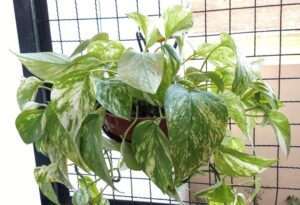
Pruning for Length and Shape Control
Controlling the length and shape is the most practical part of pruning for most pothos owners and it is also the simplest – you are deciding where you want the vines to stop and cutting them there. What you have to think about is how aggressively you cut and how to create a balanced, even appearance across the whole plant.
How Much Can You Cut?
A pothos tolerant of being cut. More so than most houseplants.
You can remove up to two thirds of a vine in a single cut and the plant will recover without any problem. You can cut every vine in the pot back to a few inches from the base and the plant will produce new growth from every remaining node.
I wouldn’t recommend doing that – it’s a bit extreme and the plant will look drastically pruned for several weeks. But it is genuinely not possible to prune a healthy pothos to the point of permanent harm through cutting on its own.
Taking a more moderate approach will get you better looking results in the short term though. Cutting vines back by about half their length removes the bare, leafless sections that build up at the base of long vines.
The result is a plant that looks good immediately after pruning as well as in the months following it rather than a collection of bare stubs waiting for new growth to appear.
Creating Even, Balanced Vines
A well pruned pothos has vines of roughly similar lengths that give the plant a balanced appearance when you look at it from all angels. You can get this by measuring each vine as you go – holding it next to the others and cutting to a consistent length rather than cutting each vine to a different point you’ve picked out. This sounds fussy but takes very little extra time and the difference in how it will look when you’ve carefully cut it evenly as opposed to haphazardly is significant.
For hanging baskets think about the viewing angle. A pothos in a hanging basket is usually viewed from below and the sides, so you want it even at the vine tips.
If you have a pothos that is trailing from a shelf the view is usually from the side and front. So the upper vines near the pot should be even, and that will matter more than being perfectly uniform at the trailing ends.
Dealing With Very Long, Bare Vines
Long pothos vines that have become bare at the base – all the lower leaves have dropped and only the last third of the vine has any leaves – are one of the most common problems with pothos and how they look. The fix is to cut those vines back to just above the top surviving node on the section that has no leaves.
This can feel like a big step – you are cutting back to a point much closer to the pot than the current vine length – but the result is that the node you have cut above will give you new growth and that new growth comes from a point close to the pot where you actually want the fullness to be.
The bare section you cut away can be divided into node cuttings and propagated. Even a very long section of stems with bo leaves with multiple nodes can produce several new plants – each node section will root and eventually produce new leaves. This is one of the more satisfying pothos propagation projects because you end up with multiple new plants from material that would otherwise just be thrown away.
Training Climbing Pothos
Pothos can be trained to climb things like a moss pole, trellis or coir support. Climbing pothos will produce larger leaves than trailing ones too – the climbing habit is like the plant’s natural behaviour of climbing up tree trunks in the wild, which triggers larger leaf production.
For a climbing pothos, pruning to control it’s shape means removing vines that are growing away from the support and making the plant’s energy go toward the stems that are climbing. Cut back stems that grow backwards to just above a node close to the support. And use plant ties or clips to get any new growth to attach to the pole instead of trailing out.
For more help see our tips to get your pothos to climb.
Pruning to Get Bushier, Fuller Growth
This is what makes the biggest difference to how a pothos looks and the one that most people either do not know about or do not understand well enough to do well. A pothos left to grow in one direction will becomes more and more sparse as time goes on – the growing tip moves further from the pot, lower leaves age and drop and the base becomes bare.
Pruning to reverse this pattern is what gives you a dense, full plant.
Why Cutting Makes a Pothos Fuller
When you cut a pothos vine you remove the growing tip. That growing tip was the dominant growing point on that vine – it was where the energy was being sent to for growth, and the nodes below it were dormant because the tip was active.
Once the tip is removed those dormant nodes below the cut aren’t suppressed and they activate and grow new shoots. Each of those new shoots has its own growing tip, and each then produces its own set of leaves.
Over time a vine that was cut produces not one new vine but potentially two, three or more new branches from the nodes below the cut. Each time you prune that shortens long vines to lower nodes increases the total number of active growing tips in the pot, which is what makes the plant look fuller. A pothos with twelve growing tips that are all active looks a whole lot fuller than a pothos with four, even at the same overall size.
The Specific Approach for Maximum Fullness
For a pothos you want to make bushier rather than just tidier cut each vine back further than you would when controlling the length – to a node that is close to the pot, ideally within the top 15 to 30cm (6 to 12 inches) of vine. This will probably feel quite aggressive because it removes most of the current vine but the growth that comes from the nodes left behind is what builds the density you are after.
Do this across all the vines in the pot at once rather than one or two at a time. Doing so will give you the fastest results – within four to eight weeks you should see multiple new shoots are emerging from nodes across all the vine sections that are left and the pot begins to look fuller from the base.
Propagating Cuttings Back Into the Same Pot
The fastest route to a full, dense pothos isn’t just cutting back the existing vines but also propagating cuttings back into the same pot. Once the cuttings you took from pruning have rooted – usually about two to four weeks in water – pot them back into the same container alongside the parent plant.
Each rooted cutting becomes an extra vine, so you increase the total number of stems and in turn the density of the plant. This all is a lot faster than waiting for the cut parent plant to branch on its own.
This is how plant nurseries produce the impressively full pothos that look like they have been growing for years. It is not a trick; it is just understanding how the plant works.
For more help see our guides to propagating pothos and propagating it in water.
The Time Factor
Getting a pothos sense takes time even with the right technique. A plant cut back will look sparse for four to eight weeks while the new growth develops.
You need to have patience during this time – the plant looks worse than it did before pruning, and it can feel like you have made a mistake. But you haven’t.
New shoots from cut nodes are small at first, then unfurl over the next few weeks into full sized leaves. By the end of the growing season following a spring prune a pothos that was pruned aggressively for bushiness looks a lot fuller than it did before pruning, with more leaves along shorter vines.
What to Do With Cuttings: Propagation
Propagating a pothos is one of the simplest of all the houseplants and usually one of the most successful. It’s fast and the cuttings you take from pruning are ready to root with no special treatment needed.
The only way to get a pothos cutting wrong is to take one without a node – which is why understanding where nodes are is important.
What a Good Pothos Cutting Looks Like
A pothos cutting that’s ready to be propagated has one node and at least one leaf. The node is where the roots will come from.
The leaf photosynthesizes and so gives the cutting the energy to develop roots and sustain itself while it is getting established. A cutting with more than one node is fine – it will just produce roots from multiple points and develop into a more established plant faster.
A cutting with a node but no leaf can root but does so more slowly than one with a leaf. This is because it has ability to photosynthesize and support the process.
When taking cuttings from a pruned vine cut the vine into individual sections of nodes – one node, one leaf, 2 to 5cm of stem below the node. Do not include the bare end of the vine (above the last leaf) in any cutting – that has no node and so cant root. The last useable cutting from a vine is the one that includes the tip and the leaf just below it; the bare section above the tip’s leaf is discarded.
Water Rooting: The Most Popular Method
Pothos root in water well and quickly and water rooting let you see the roots grow – one of the reasons it is the most popular propagation method.
Put the cutting in a clean glass or jar of room temperature water with the node fully covered in water and the leaf sticking out of it. A single node with one leaf per container is best for keeping an eye on how they’re getting on but multiple cuttings can share a container if you have a lot of them.
Make sure the jar is in bright indirect light – not direct sun which overheats the water and can lead to algae growing. Change the water every five to seven days to keep it fresh and full of oxygen.
Roots usually begin to appear within one to two weeks which is faster than most other houseplants. By three to four weeks the roots are around 3 to 5cm long and the cutting is ready to be potted in compost.
Moving them from water to compost takes some care – water roots and soil roots have some different characteristics and the cutting can look stressed for a week or two after the transition. Use a very well draining, slightly moist compost mix rather than a wet one and keep the compost moist (not wet) for the first few weeks to help with the transition. The plant adjusts quickly and new leaves growing following the transition is a good sign that the roots have adapted successfully.
Direct Compost Rooting
Pothos cuttings can also be rooted right into compost, skipping the water phase entirely. This gives you roots adapted to soil conditions from the start, which means the cutting goes from cutting to growing plant without any stress from the transition. The tradeoff is that you don’t get to see the roots developing and have to rely on new leaves growing as your indicator of success.
Put the cutting in a small pot of moist, well draining compost with the node buried just below the surface and the leaf above it. You can also put some rooting hormone powder on the node end before you plant it. You will get a little improvement in how fast it roots and the success rate but it is not necessary for pothos – they root without any assistance.
Cover with a clear plastic bag or propagation dome to keep the humidity levels stable, put it in bright indirect light and keep the compost moist. New growth should appear within four to six weeks.

What to Do With Cuttings That Don’t Have a Leaf
An area of stem that’s bare that has nodes but no leaves – which is common from the lower part of long, bare pothos vines – can still be propagated but it is slower. Without a leaf the cutting has no photosynthesis to support the roots developing and relies entirely on stored energy in the stem.
Put it in moist sphagnum moss or directly in moist compost, maintain the humidity and then wait. A new leaf will eventually emerge from one of the nodes, at which point the cutting has the resources it needs to develop properly.
This can take two to four months and some cuttings fail before they produce a leaf. It’s worth trying if you have the patience and a some extra bare stem cuttings but not worth getting attached to any individual result.
Aftercare Following Pruning
Pothos is the least demanding of all houseplants when it comes to care after you’ve been pruned. Unlike orchids, monsteras or many other houseplants, a pruned pothos does not need any special handling, reduced watering, a recovery period in less light or any particular aftercare outside of the normal maintenance you’d give them. That said, a few small adjustments in the weeks after pruning will help support faster recovery and get you better results.
Watering After Pruning
Pothos can be watered normally right after pruning. There is no need to withhold water for a drying period.
If the plant was due watering, water it. If it was watered recently and the compost is still moist, wait until the top inch is dry as normal.
The fact there are fewer leaves after pruning means it transpires a little less moisture than before, so you may find the compost takes a bit longer to dry than usual. But all you have to do is adjust how often you’re watering and let the soil tell you when to water rather than following a fixed schedule.
For more help see our pothos watering guide.
Light: Keep It Consistent
After pruning keep the plant in the same light position it was in before. Do not move it to a darker spot to rest it – pothos need light to fuel the new growth and less light slows the process.
Equally a recently pruned pothos that was previously growing in lower light does not suddenly need bright light to recover – the same conditions that sustained it before pruning will sustain it after.
One thing worth noting: if the pothos was growing in low light and the vines were leggy because of it now is the best time to move it to a brighter spot. The pruned plant in better light will produce more compact and well spaced new growth instead of the leggy stretched growth that caused the problem in the first place. Pruning and a light upgrade together produce a far better result than either alone.
For more help with the right light see our guide to the correct lighting for pothos.
Feeding After Pruning
Do not fertilise for two to three weeks after pruning. The plant’s reduced leaf area means has less ability to take up nutrients (temporarily) and any fertiliser applied during this period can build up as salts in the growing medium rather than being used.
Resume feeding with your normal balanced liquid fertiliser once you can see new growth emerging from the pruned stems – that should be about three to six weeks after pruning in the spring and summer.
What to Expect and When
New growth on a pruned pothos comes from the nodes left behind by your cuts. The timeline depends on the time of year and the levels of light:
- Spring and summer pruning: New shoots are usually visible within two to four weeks. Within six to eight weeks there should be multiple new leaves unfurling from the pruned nodes and the plant looking fuller than it did when you pruned it.
- Autumn pruning: New growth within four to six weeks if the plant is in reasonable light. Slows significantly through midwinter and may stop almost entirely in low light in December and January before resuming in the late winter.
- Winter pruning: Recovery is slowest. New growth may not appear for six to eight weeks and will be modest until the days begin to get longer in the late winter. Not ideal timing but the plant will recover and the wait is worth it.

When Something Looks Wrong
Occasionally after pruning a pothos one or two of the remaining leaves on a pruned vine will turn yellow and drop off. This is usually the leaf immediately below the cut – the closest leaf to the cut surface, which sometimes goes yellows as a reaction to the physical stress of the cut near it.
It is not a cause for concern though. Just remove the yellow leaf and the vine will continue producing new growth from the node below. It is not a sign that the pruning was done wrong or that the plant is in trouble.
If multiple leaves are turning yellow on vines that were not recently cut or if the whole plant looks progressively worse rather than gradually recovering after pruning the problem is not the pruning – it is a pre existing condition that was already developing before you cut.
Check how you’re watering it, the health of its roots and the light levels before deciding that the pruning caused the problem. Pruning does not cause root rot, overwatering or pest infestations, but it may temporarily reveal problems that were already present by reducing the plant’s ability to cope with them.
I pruned a large golden pothos in a hanging basket last spring – cut every vine back to about 15cm from the pot, which felt like a lot given that the longest vines were nearly 120cm. After three weeks I was seeing small new shoots at most of the cut nodes. By eight weeks the basket was producing new growth from probably thirty different points and looked fuller than it had in two years of unpruned growth.
By autumn it was one of the better looking plants in the room. The pruning that felt over the top produced the best result. So don’t worry about going wrong or doing too much.
